Blog

Tag: news

  • July 22nd, 2012 1:18am

    The day after Columbine, I was interviewed for the Tom Brokaw news program. The reporter had been assigned a theory and was seeking sound bites to support it. “Wouldn’t you say,” she asked, “that killings like this are influenced by violent movies?” No, I said, I wouldn’t say that. “But what about Basketball Diaries?” she asked. “Doesn’t that have a scene of a boy walking into a school with a machine gun?” The obscure 1995 Leonardo Di Caprio movie did indeed have a brief fantasy scene of that nature, I said, but the movie failed at the box office (it grossed only $2.5 million), and it’s unlikely the Columbine killers saw it. The reporter looked disappointed, so I offered her my theory. “Events like this,” I said, “if they are influenced by anything, are influenced by news programs like your own. When an unbalanced kid walks into a school and starts shooting, it becomes a major media event. Cable news drops ordinary programming and goes around the clock with it. The story is assigned a logo and a theme song; these two kids were packaged as the Trench Coat Mafia. The message is clear to other disturbed kids around the country: If I shoot up my school, I can be famous. The TV will talk about nothing else but me. Experts will try to figure out what I was thinking. The kids and teachers at school will see they shouldn’t have messed with me. I’ll go out in a blaze of glory.

    In short, I said, events like Columbine are influenced far less by violent movies than by CNN, the NBC Nightly News and all the other news media, who glorify the killers in the guise of “explaining” them. I commended the policy at the Sun-Times, where our editor said the paper would no longer feature school killings on Page 1. The reporter thanked me and turned off the camera. Of course the interview was never used. They found plenty of talking heads to condemn violent movies, and everybody was happy.“

    Roger Ebert (via ibad)

    And the media is still exactly the same. 13 years and multiple mass shootings later, the media still treats these atrocities the same. 

    (via wherethemindroams)


  • July 17th, 2012 1:13pm


    discoverynews:

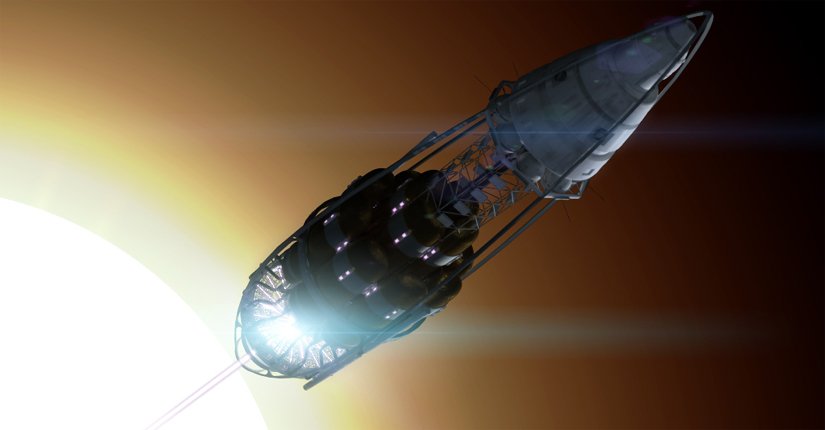
    VARIES: The Fastest Starship to Proxima Centauri?

    The problem with space is that it’s big. Really, really big. To get to the nearest planet in our solar system takes months at best. But say if you wanted to travel to the nearest star?

    This question is currently being considered by a team of scientists and engineers from Icarus Interstellar Inc., one of a group of organizations chosen to spearhead DARPA’s 100 Year Star Ship (100YSS) project.

    The aim of 100YSS is to formulate plans to send humans to in interstellar destination — such as Proxima Centauri, a little over 4 light-years from Earth — within the next century.

    But Richard Obousy, President and Co-Founder of Icarus Interstellar, introduced the Vacuum to Antimatter-Rocket Interstellar Explorer System (VARIES) — an unmanned prototype starship — to Discovery News readers on Monday as one of the projects Icarus is working on to make our interstellar dreams come true.

    With the help of the stunning artwork by Adrian Mann, take a look at how this futuristic technology may be able to unlock antimatter from the vacuum of space and use it to propel the ultimate interstellar spaceship.

    keep reading


  • July 12th, 2012 4:11pm

    discoverynews:

    scientists cut open the stomachs of 67 northern fulmars, a type of seabird, which had died and been beached on the coasts of British Columbia, Washington and Oregon […] Nearly 93 percent of the birds harbored plastic in their stomachs, the research team reported in the journal Marine Pollution Bulletin. And each bird contained an average of nearly 37 pieces of plastic. One bird had 454 pieces in its stomach.

    Read more of Emily Sohn’s article, “Pacific NW Seabirds Stuffed Full of Plastic

    So, so wrong. 


  • July 11th, 2012 7:59pm


    reuters:

    Scientists are using the world’s biggest telescope, buried deep under the South Pole, to try to unravel the mysteries of tiny particles known as neutrinos, hoping to shed light on how the universe was made.

    The mega-detector, called IceCube, took 10 years to build 2,400 meters below the Antarctic ice. At one cubic km, it is bigger than the Empire State building, the Chicago Sears Tower – now known as Willis Tower – and Shanghai’s World Financial Center combined.

    Designed to observe neutrinos, which are emitted by exploding stars and move close to the speed of light, the telescope is attracting new attention in the wake of last week’s discovery of a particle that appears to be the Higgs boson – a basic building block of the universe.

    “You hold up your finger and a hundred billion neutrinos pass through it every second from the sun,” said Jenni Adams, a physicist at the University of Canterbury in New Zealand, who works on IceCube.

    READ ON: Giant ice telescope hunts for dark matter’s space secrets


  • June 30th, 2012 1:38pm


    The Library of Utopia

    In his 1938 book World Brain, H.G. Wells imagined a time—not very distant, he believed—when every person on the planet would have easy access to “all that is thought or known.”

    The 1930s were a decade of rapid advances in microphotography, and Wells assumed that microfilm would be the technology to make the corpus of human knowledge universally available. “The time is close at hand,” he wrote, “when any student, in any part of the world, will be able to sit with his projector in his own study at his or her convenience to examine any book, any document, in an exact replica.”

    Wells’s optimism was misplaced. The Second World War put idealistic ventures on hold, and after peace was restored, technical constraints made his plan unworkable. Though microfilm would remain an important medium for storing and preserving documents, it proved too unwieldy, too fragile, and too expensive to serve as the basis for a broad system of knowledge transmission. But Wells’s idea is still alive. Today, 75 years later, the prospect of creating a public repository of every book ever published—what the Princeton philosopher Peter Singer calls “the library of utopia“—seems well within our grasp. With the Internet, we have an information system that can store and transmit documents efficiently and cheaply, delivering them on demand to anyone with a computer or a smart phone. All that remains to be done is to digitize the more than 100 million books that have appeared since Gutenberg invented movable type, index their contents, add some descriptive metadata, and put them online with tools for viewing and searching.

    (read more)

    (photo credit)


  • June 30th, 2012 1:19pm


    blog.instagram.com

    Thousands of protesters gathered in front of the Japanese prime minister’s house on Friday to protest the government’s decision to reopen a nuclear power plant in western Japan.

    Protests are uncommon in Japan, but the decision to reactivate the Ohi power station 16 months after the tsunami that caused a meltdown at the Fukushima power plant has set of a series of demonstrations across the country.

    The Ohi reactor is scheduled to be reactivated on Sunday.