Nature’s not us; it’s different. A part of us is nature, but that part of us that’s human and free is opposed to nature. What there is of the natural worlds that seems human to us is what we have projected out upon it from our own hearts. We created cities, roads, factories, ect. Sunset, waterfalls, and landscapes are but a few accidental aspects of nature that we happen to like, that somehow reflect moods of ours…So we are prone to forget all of the other phases of nature that are terrible, inhumane, and alien to us.
Tag: literature
-
-
March 24th, 2013 11:33pm
Of all organs, the tongue is the most remarkable. For we use it to taste our sweet wine and bitter poison, thus also do we utter words both sweet and sour with the same tongue.— Neil Gaiman, The Graveyard Book (via o-ver-ture)
-
March 18th, 2013 7:41pm
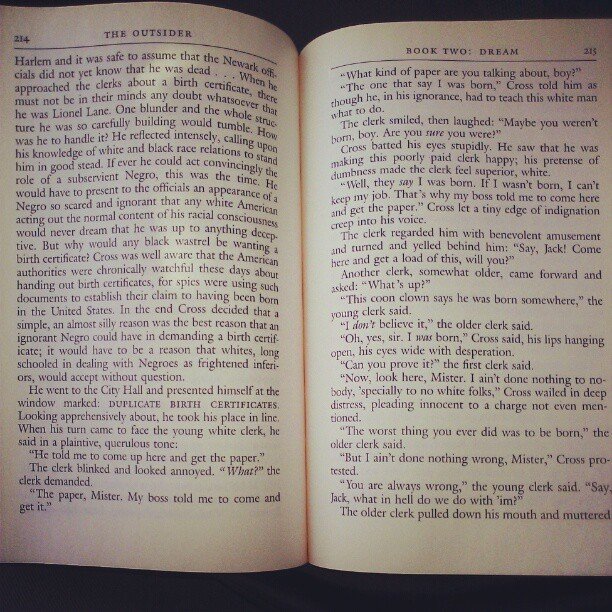
The Outsider by Richard Wright
“We Communists do not admit any subjectivity in human life,” Gil said with a slow, even smile, as though proud that he could utter such a horrible statement with such lightmindedness.
“I see,” Cross said, striving to keep his voice neutral. He was seething with resentment at Gil’s effrontery. Who in the hell does he think he is? He had to brace himself to keep from taking issue not only with Gil’s statement but with the whole attitude toward life implied in it. Cross felt himself slowly coming awake, feeling the real world about him. Here was a challenge the measure of which might meet his needs…Keep still, he told himself.
“Do you know anything about the revolutionary movement?”
“I know it sketchily in general outline, from 1917 onwards -”
“Where did you pick it up?”
“From books, of course. What do you think?” Cross had difficulty keeping irritation out of his voice.
“Accounts written by counter-revolutionary historians, no doubt,” Gil pronounced placidly. He brought out his pipe and began to fill it leisurely with an aromatic tobacco.
Cross had come by his account of the Russian Revolution from the pens of Russian Bolsheviks themselves, but he did not bother to correct Gil’s assumption. He sensed that accuracy was no the point here. Gil was trying to impress him, not with learning, but with some attitude of scorn so deep that argument was futile against it. Instead, he took advantage of Gil’s silence to observe Eva who sat with her shapely nyloned knees close together and regarded him with wide, enigmatic eyes. When his gaze met hers, she smiled and looked off. She seemed tense, yet rigidly contained. She was a fragile girl of about twenty-four; her attitude was so distracted that one could feel that she would never speak frankly what was really on her mind. Despite this, she seemed kind, impulsive. Her eyes were a clear hazel; her nose small and straight; and her mouth, which was only slightly rouged, was almost severe in its sharpness. The overall aspect of her face, despite the shadow of a smile the flitted over it now and then, was one of tortured, organized concentration. Cross wondered how on earth had she come to be married to a coarse, inhuman character like Blount. Cross now shifted his gaze to Gil and was chagrined to find that Gil had been observing his observation of Eva. Gil smiled tolerantly and Cross found himself boiling with rage. He thinks I’ve never met a white girl before…
Something decisive was transpiring in him regarding Gil. He knew that Gild did not take his inner life into account he felt compelled to do the same with Gil. This damn thing’s catching, he told himself. You have to descend to their level if you are to deal with them…There’s no other way out…But he really liked this; there was an absoluteness about it that appealed to him, excited him. To grapple with Gil would involve a total mobilization of all the resources of his personality, and the conflict would be religious in its intensity.
Finished this book a few days ago and I’m now going back and looking over all the shit that I bookmarked/highlighted.
This whole scene between Cross and Blount is intense and probably one of the best written confrontations that I’ve ever read. I don’t want to give anything else away, so I’ll let you go pick up a copy and find out what happens if you’re interested lol.
-
March 18th, 2013 12:25pm
-
March 17th, 2013 7:56pm
Every time he thought he was going mad, he met somebody else who had already gone mad, but in a nice, sweet sort of way.
-
March 8th, 2013 12:14am
If you’ve a notion of what man’s heart is, wouldn’t you say that maybe the whole effort of man on earth to build a civilization is simply man’s frantic and frightened attempt to hide himself from himself? That there is a part of man that man wants to reject? That man wants to keep from knowing what he is? That he wants to protect himself from seeing that he is something awful? And that this ‘awful’ part of himself might not be as awful as he thinks, but he finds it too strange and he does not know what to do with it? We talk about what to do with the atom bomb…But man’s heart, his spirit is the deadliest thing in creation. Are not all cultures and civilizations just screens which men have used to divide themselves, to put between that part of themselves which they are afraid of and that part of themselves which they wish, in their deep timidity, to try to preserve? Are not all of man’s efforts at order an attempt to still man’s fear of himself?—The Outsider by Richard Wright
Easily the best novel I have ever read. It’s thoughtful and reflective on a level that’s so far above and beyond just about anything else that I’ve ever read.
-
February 26th, 2013 1:14pm
You can live your life through and try hard to be a decent sort, but trouble might still come to you.— So Young, So Fair, So Dead by John Lutz
-
February 12th, 2013 1:51pm
-
February 5th, 2013 12:38pm
“Lena asked me to leave,” Xiu told him. “Maybe I pushed her too hard.” But I know where she lives now! I could go there. I could make her see how much I’ve changed. And maybe that would just prove that he had changed in all the ways that didn’t matter. So Robert didn’t drive out to Rainbow’s End; he didn’t snoop the public cams there. But he continued to write her. And when he was outside, he often imagined that besides that 7-by-24 attention of the security authorities, perhaps there was another watcher, one who would someday forgive him.— Rainbow’s End by Vernor Vinge.