Tag: authors
-
-
September 10th, 2012 1:27pm
Damn — I just clicked “answer privately” on something I meant to answer publicly, and once you’ve answered privately it has gone from your inbox. So if you’re the person who had read Good Omens & needed a hand, write back.
He seems like such a nice guy.
-
August 30th, 2012 12:29pm
You can never be overdressed or overeducated.— Oscar Wilde (via kari-shma)
-
August 26th, 2012 12:54am
Pro-tip for writers,
because I’ve been seeing this a lot.
To be is the most common of the linking verbs and also the most overused, but all the linking verbs invite generalization and distance. To feel, to seem, to look, to appear, to experience, to express, to show, to demonstrate, to convey, to display – all these suggest in fiction that the character is being acted upon or observed by someone rather than doing something. She felt happy/sad/amused/mortified does not convince us. We want to see her and to infer her emotion for ourselves. He very clearly conveyed his displeasure. It isn’t clear to us. How did he convey it? To whom?
Most linking verbs have active as well as effectively passive forms, and it is important to distinguish them. She felt sad is effectively passive, but she felt his forehead is an action. If the magician appeared, he is acting; but if he appeared annoyed, then the verb is a linking verb and the only action implied is that of the observer who perceives this.
Linking verbs, like the passive voice, can appropriately convey a sense of passivity or helplessness when that is the desired effect.
From Writing Fiction: A Guide to Narrative Craft by Janet Burroway
-
August 25th, 2012 1:59pm
Novelists and short-story writers are not under the same obligations as poets to reinforce sense with sound. In prose, on the whole the rhythm is all right if it isn’t clearly wrong.— Janet Burroway – Writing Fiction; A guide to narrative craft
-
August 24th, 2012 8:16pm
Reality is that which, when you stop believing in it, doesn’t go away.— Philip K. Dick (via trevoredwards)
-
August 21st, 2012 5:08pm
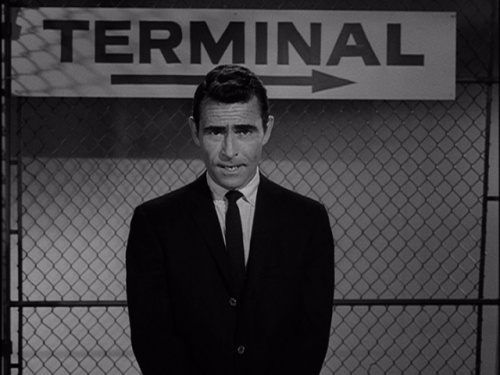
“Every writer is a frustrated actor who recites his lines in the hidden auditorium of his skull.” –Rod Serling
-
August 21st, 2012 12:06am
This is a short book because most books about writing are filled with bullshit. Fiction writers, present company included, don’t understand very much about what they do – not why it works when it’s good, not why it doesn’t when it’s bad. I figured the shorter the book, the less the bullshit.— Stephen King (via trevoredwards)
-
August 20th, 2012 10:52pm
Any sufficiently advanced technology is indistinguishable from magic.— Arthur C. Clarke (via rexsantus)
-
August 20th, 2012 12:50pm
A human being should be able to change a diaper, plan an invasion, butcher a hog, conn a ship, design a building, write a sonnet, balance accounts, build a wall, set a bone, comfort the dying, take orders, give orders, cooperate, act alone, solve equations, analyze a new problem, pitch manure, program a computer, cook a tasty meal, fight efficiently, die gallantly. Specialization is for insects.— Robert A. Heinlein (via trevoredwards)