
Babeee

Your blog category
Babeee
message to all friends please don’t smoke resin it has no thc the only high you’re getting is a jank-ass high from suffocating from all the garbage you just inhaled
FUCK YEAH SO LIGHT HEADED
INTERVIEW: SAM HUMPHRIES ON ‘LEGENDARY STAR-LORD’ AND THE WEIRD HISTORY OF MARVEL’S NEXT MOVIE STAR
By Chris Sims
Of all the Marvel characters who have made it to the big screen over the past few years, none have seemed less likely than Peter Quill. An obscure sci-fi character who debuted in the ’70s and made a handful of appearances in his first three decades of existence, he rose to fame during the Annihilation crossover as the leader of the Guardians of the Galaxy, a ragtag band of spacefaring heroes who battled evil across the stars.
Now, with a Guardians of the Galaxy movie set to debut this summer, Peter Quill is getting his first ever ongoing series as The Legendary Star-Lord, thanks to Sam Humphries (Avengers A.I., Sacrifice), artist Paco Medina (Nova, Ultimate Comics X-Men) and colorist David Curiel. To find out more, I spoke to Humphries about the history of Star-Lord, how his obscurity helped to propel him to fame, and why his hair has to stay gloriously uncovered.
ComicsAlliance: Is there something about these characters who don’t have that long history that makes them inherently appealing to you as a creator, or as a fan?
Sam Humphries:Just on a real practical level, it’s like, Wolverine has so many appearances and pages devoted to him over the years that he comes with a lot of baggage. In terms of a creator’s appeal with these much more obscure characters, you have much more of a blank slate, and you have a freedom to interpret them in a fresh new way. Wolverine has been constantly reinterpreted for the modern day, whatever the “modern day” happens to be on that particular date.
For fans, I think you can come to it with, I guess, less anxiety in your heart when that character gets revamped. When you revamp Wolverine, before it’s even announced, people are going to be up in arms about it. But for Star-Lord, pre-Annihilation, who didn’t have a huge fanbase, you didn’t have people second-guessing everything you’re doing, and readers can come to that reading experience with a much more open heart and less fear clouding their reading experience. I think there’s something that’s definitely attractive there.
And if we’re talking about how an obscure character like Star-Lord went from his humble origins to headlining this summer blockbuster, I think you have to give all the credit to Dan Abnett and Andy Lanning for the way that they took the character, reinterpreted him, and really executed him into this compelling, charming, adventurous, fun character. I think having an obscure character has its advantages, but with any character, it comes down to the talent of the creator behind him.
CA: So what you’re saying is that Star-Lord is definitely, 100% better than Wolverine.
Wow, Humphries really hit the nail on the head there with revamps.
Addicts annoy me in a way that nothing else quite does…and my city is FULL of them.
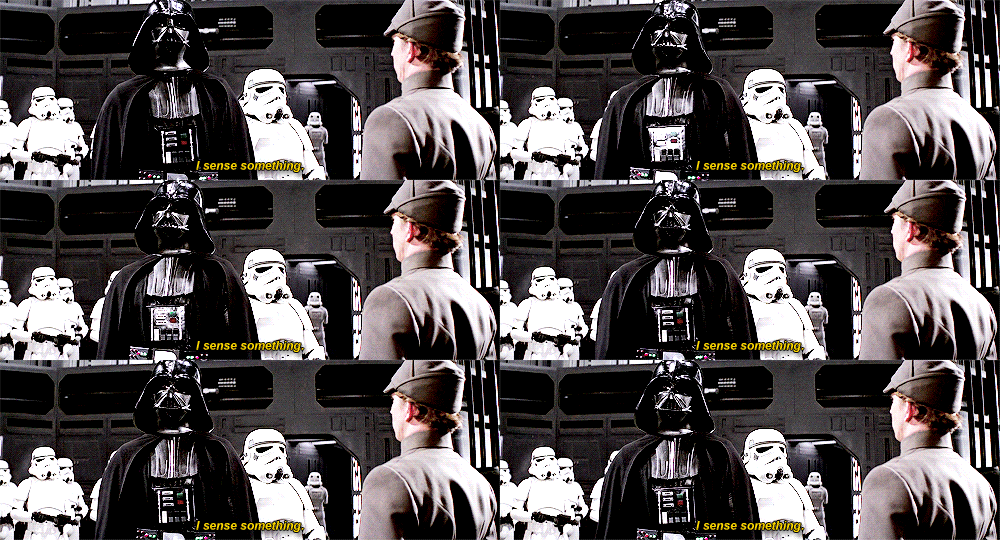
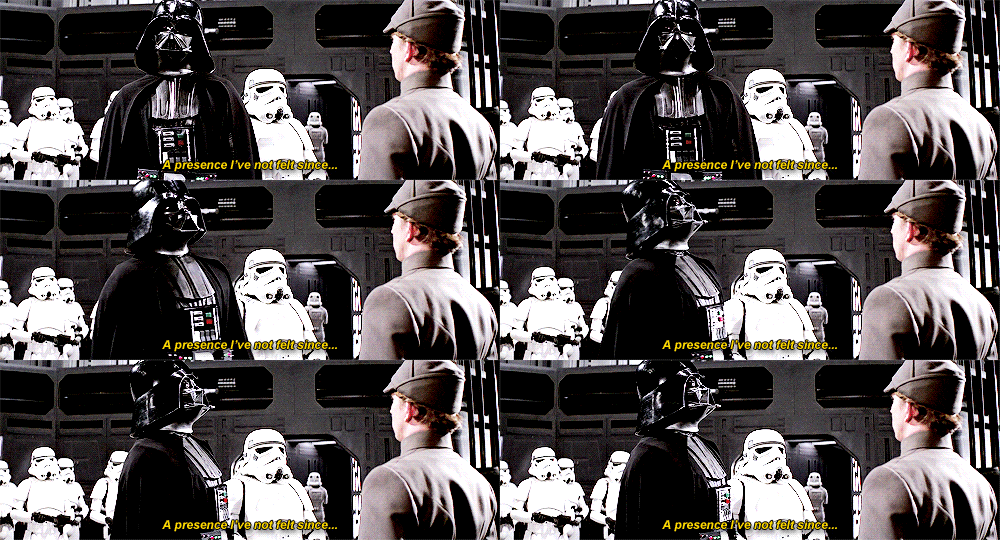
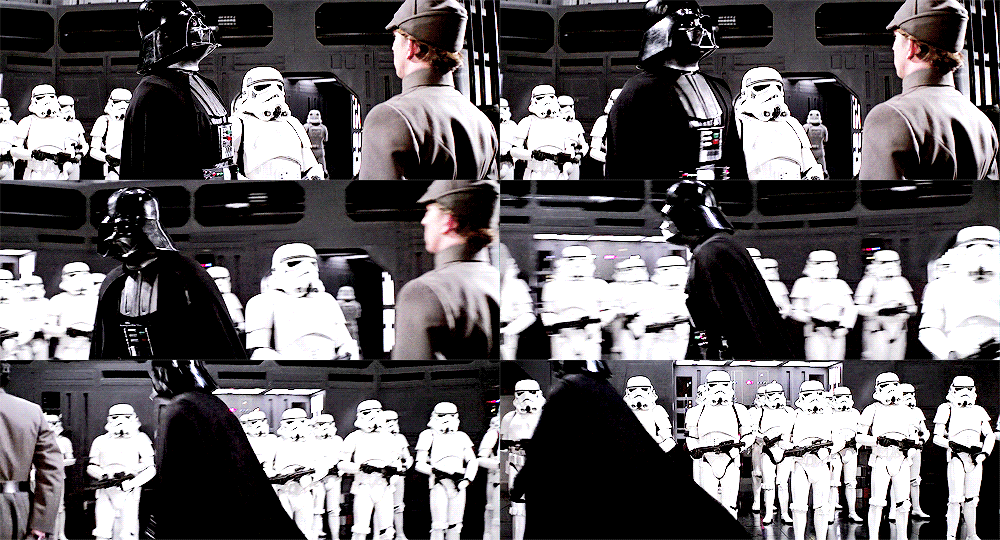

Probably one of the saddest comics I’ve ever read.

“I’ve learned that people will forget what you said, people will forget what you did, but people will never forget how you made them feel”
R.I.P. Maya Angelou, you absolute star
Jamie Raskin – who is now a senator in Maryland and served as floor manager of the recently passed bill allowing same sex marriage.
OH SNAP, SON.
(via razzledazzy)
A new NASA study shows Earth’s climate likely will continue to warm during this century on track with previous estimates, despite the recent slowdown in the rate of global warming.
This research hinges on a new and more detailed calculation of the sensitivity of Earth’s climate to the factors that cause it to change, such as greenhouse gas emissions. Drew Shindell, a climatologist at NASA’s Goddard Institute for Space Studies in New York, found Earth is likely to experience roughly 20 percent more warming than estimates that were largely based on surface temperature observations during the past 150 years.
To put a number to climate change, researchers calculate what is called Earth’s “transient climate response.” This calculation determines how much global temperatures will change as atmospheric carbon dioxide continues to increase – at about 1 percent per year — until the total amount of atmospheric carbon dioxide has doubled. The estimates for transient climate response range from near 2.52 F (1.4 C) offered by recent research, to the IPCC’s estimate of 1.8 F (1.0 C). Shindell’s study estimates a transient climate response of 3.06 F (1.7 C), and determined it is unlikely values will be below 2.34 F (1.3 C).
Shindell’s paper further focuses on improving our understanding of how airborne particles, called aerosols, drive climate change in the Northern Hemisphere. Aerosols are produced by both natural sources – such as volcanoes, wildfire and sea spray – and sources such as manufacturing activities, automobiles and energy production. Depending on their make-up, some aerosols cause warming, while others create a cooling effect. In order to understand the role played by carbon dioxide emissions in global warming, it is necessary to account for the effects of atmospheric aerosols.
“Working on the IPCC, there was a lot of discussion of climate sensitivity since it’s so important for our future,” said Shindell, who was lead author of the IPCC Fifth Assessment Report’s chapter on Anthropogenic and Natural Radiative Forcing. “The conclusion was that the lower end of the expected warming range was smaller than we thought before. That was a big discussion. Yet, I kept thinking, we know the Northern Hemisphere has a disproportionate effect, and some pollutants are unevenly distributed. But we don’t take that into account. I wanted to quantify how much the location mattered.”
Shindell’s climate sensitivity calculation suggests countries around the world need to reduce greenhouse gas emissions at the higher end of proposed emissions reduction ranges to avoid the most damaging consequences of climate change. “I wish it weren’t so,” said Shindell, “but forewarned is forearmed.”
Continue reading @ NASA