‘;
Interpol – Lights

Interpol – Lights
capacity replied to your post: Just finished editing my final essay for my…
post itttt
Comic Books: Harmful or Helpful?
[[MORE]]
When you think of comic books, the first thing that probably pops into your mind is a flamboyantly dressed hero with exaggerated words like BAM or POW hovering over their head. Unfortunately, this generalization is the extent of what most people know about comic books, and has led to the idea that comics are nothing but picture books for children. However, that notion is simply not true. Comic books have a rich history of being ground breaking, educational and, of course, fun. Even still, the opinion of comics has remained negative and generalized, preventing the medium from remaining widely exposed and available.
One of the contributing factors to the stigma surrounding comic books has been the lasting impressions of early critics. In 1940, Sterling North, a reviewer for the Chicago Daily News, described comic books as, “badly drawn, badly written, and badly printed – a strain on the young eyes and young nervous systems” (Coville). This caused companies like DC Comics, who was the largest comic publisher at the time, to put together editorial boards to show citizens that comic books were being held up to standards of wholesome entertainment. These boards were formed with psychiatrists, child welfare experts, and some famous, well respected citizens. The board members’ names were printed on the inside cover of all DC books, an action that did help to relieve some of the criticism that comic books had come under, but not for long. In 1948, well respected psychiatrist, Dr. Fredric Werthham, publicly attacked comic books in an interview with Collier’s Magazine. Dr. Werthham conducted a seven-year study of the effects that comic books had on children. The study reported that the portrayal of sex and violence in comic books encouraged similar behavior in children. In the interview, Werthham stated that, “The number of `good’ comics is not worth discussing, but the great number that masquerade as `good’ certainly deserve close scrutiny” (Coville). Several weeks after the interview, Dr. Werthham hosted a seminar in New York City called “The Psychopathology of Comic Books”, where he discussed the details of his seven year study and was able to convince many key individuals of the maliciousness that comic books held. One of the individuals that attended Dr. Werthham’s seminar was Detroit Police Commissioner Harry S. Toy, who in an interview with Time Magazine the following month claimed that upon inspection of every comic book available in his community, he found they were all, “Loaded with communist teachings, sex, and racial discrimination” (Coville). The statements and testimonies from individuals like Dr. Werthham and Commissioner Toy led to an extreme sway in public opinion which resulted in the mass burning of comic books in New York City on December 20th, 1948. Time Magazine covered the mass burning and printed pictures of Binghamton, New York residents, after a house to house collection burning comic books in the streets.
This stigma still holds strong today, with many thinking that comic books are both written and drawn by second rate artists, which couldn’t be further from the truth. Many comic book writers like Neil Gaiman, Brad Meltzer, and Geoff Johns have gone on to write bestselling novels, while artists like Alex Ross, Adam Hughes, and Jock have worked in both the film and video game industries.
For nearly seventy years the American comic book industry has struggled to maintain the public’s interest, trying desperately to reinvent characters and stories almost every generation, hoping to spark a new line of readers. This constant cycle of reinvention didn’t produce any success and by the 1980’s companies within the industry were looking for new approaches. In 1986 everything changed, DC Comics published a mini-series titled Watchmen by writer Alan Moore and artist David Gibbons, which featured a rag-tag group of six vigilantes (only one of which had any superhuman abilities) who battled their own inner demons and conflicted with each other, rather than doing battle with some extraordinary foe (DC). The book was so rich in character development, political undertones, and social commentary that it became an instant success and is now heralded as the greatest comic book of all time.
Watchmen set the tone for today’s comic books, focusing on the humanization of superheroes and incorporating political and social ideas, something that had been done too often in comic books up to this point. Yet, even with the all of the acclaim that Watchmen has received there are still many who refuse to believe that comic books can hold their own in the realm of literary worth. This rejection of comic books is quite interesting because from 1940 to 1971 an educational comic titled Classics Illustrated was printed; its purpose was to produce comic book adaptations of classic children’s literature in stylized and exciting ways. The series was so popular during its original run that its publisher often had to issue reprinting’s and was supported by many big name publishers like Doubleday and Penguin Books (Tambone).
Even today, educational comic books continue to be printed and used as learning materials for young children. Books like Scary, Gross, and Enlightening Books for Boys Grades 3-12, by Deborah Ford, utilize the page layout of traditional comic books to capture children’s attention and hold their interest in subjects like science and history. Ford’s belief is that, “Whether that book is a novel–or a graphic novel–there’s still a narrative, words on a page, and literacy involved” (Barack). As it turns out, despite what critics may say or believe, Ford’s claim is backed by research that proves that the comic book narrative is a better delivery system for information to children than traditional textbooks. In 2004, the psychology department of the University of Bath published an article in the science and philosophy journal, Endeavor, summarizing that in their research they found that, “Narratives are indeed an alternative and an important means for science communication to convey information in an accurate, attractive, imaginative and memorable way. To present scientific information through stories, novels, comics and plays should be regarded as an important means to transmit information in the repertoire of both science teachers and science communicators” (Negrete).
So, despite book burnings of the past, I think it is safe to say that comic books are more than just poorly constructed magazines targeted to waste children’s time and parent’s money. They hold stories crafted by some of the best storytellers, masterful art, and can be invaluable tools when it comes to teaching children about subjects ranging from morality to science. As author Peter David stated in his book, Writing for Comics, “Comic books are the equivalent of modern day myth building. Heck, a lot of comics even contain actual mythical characters. We should hold the texts of Superman soaring through the air, and Batman creeping through the night just as sacred as our ancestors held Zeus” (49). Comic books and their characters have become an intricate part of American culture and continue to awe and inspire us with their combination of otherworldly and down to Earth tales.
Just finished editing my final essay for my writing class. Turned out a lot better than I expected, I’m almost proud of it.
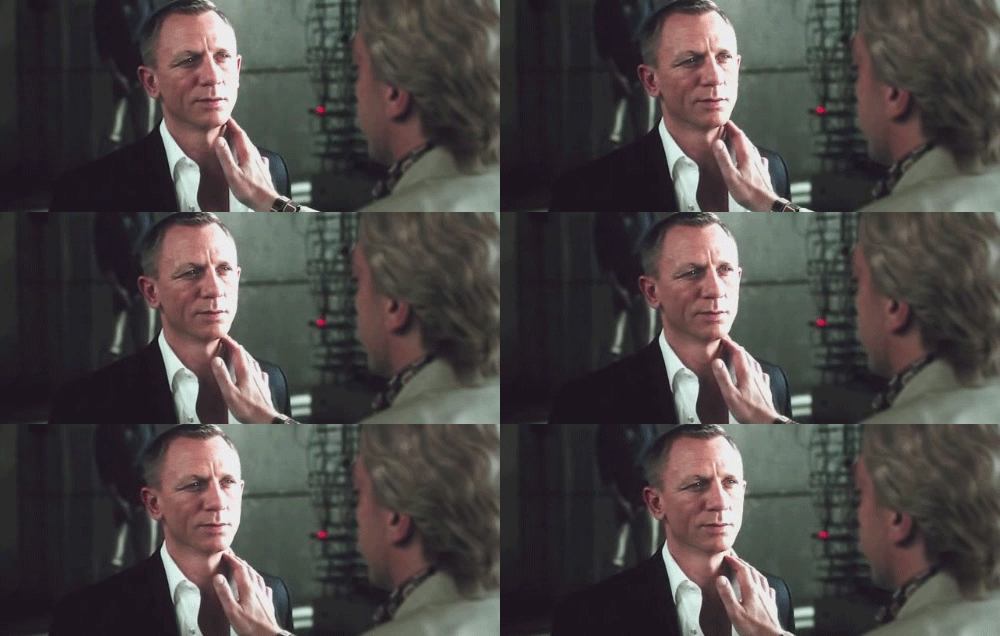

It could be said that James Bond is a cultural icon meant to reinforce a number of ideas about what it means to be a man. He’s surrounded by trappings of traditional masculinity- the perfectly fitted suit, small handgun (because a real man doesn’t need a Rambo-style machine gun to do the job), straight razor shave, uncomplicated and unsweet cocktail. For succeeding at manliness, he’s always rewarded by saving the day and having unrestricted sexual access to women.
In this scene, Silva threatens not only James Bond, but all of the masculine ideal, with rape and attempts to make that masculine ideal into an object instead of a subject. This act instantly identifies Silva as the villain- as he’s not only threatening England, but manliness as a concept. But Bond refuses to let Silva make him into an object- he returns the serve by implying that it might not be his “first time,” and by doing so, that there’s nothing inherently lesser or unmasculine about having homosexual relations. After this scene, Silva stops using emasculation as a technique and starts to go after Bond’s true weakness- his relationship with M.
This is perfectly explained
Finally someone who explains it, I am so sick of trying to tell people this.
Souls of Mischief // Limitations (feat. Del Tha Funkee Homosapien)
My limitations: Forgetting to edit my posts before clicking ‘post.’ Burnt.
“Understand this man is the grandest — the mighty dreaded — niggas step and get beheaded. Shredded, left a battered broken man, chosen hand busted from the tussle from the mic which I ignite.”

Looper (2012) written and directed by Rian Johnson
Saw this earlier tonight, definitely one of the best movies of the year.